Written in March, 2018
WARNING: Spoilers Ahead!
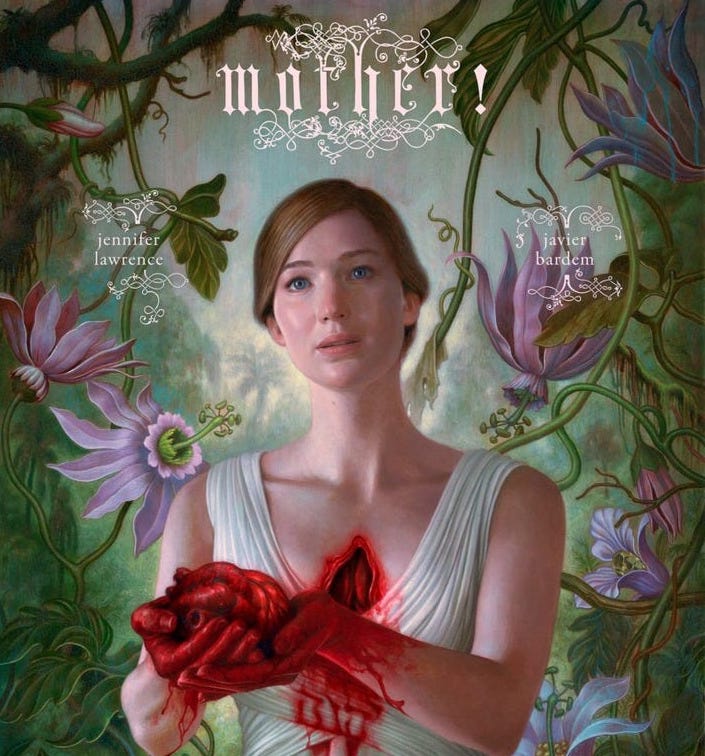
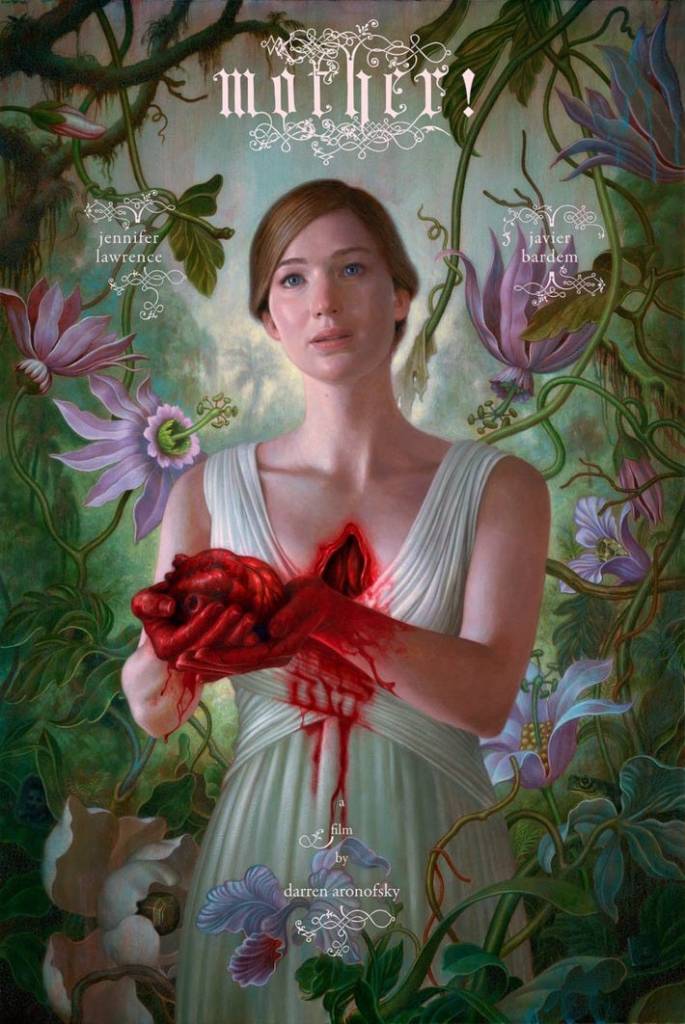
If ever there was a film that demanded an exclamation point in the title, it just might be Darren Aronofsky’s latest opus, mother!. This film earns the rebellious idiosyncrasy of its title by dangling very familiar genres right in front of us while still managing to defy our expectations. This is a risky proposition in this era where we compulsively dice all our art into hashtag-sized labels to be promptly consumed and digested by the great digital amoeba. Sure, mother! is a psychological horror film, but it’s also a biblical allegory, a home-invasion thriller, a dark comedy, a mythic fable, and, in the opinion of this cinephile, the best film of 2017.
mother! is a film that can’t be experienced with passive indifference. Sure, it has its debts to the likes of Roman Polanski and Luis Buñuel, but Aronofsky utilizes his meandering 16mm camera and his unique approach to sound design and editing to craft a film that is both intensely immersive and absolutely committed to a unique vision. In interviews, Aronofsky has described how the story came to him in a “fever dream”, which he translated into a screenplay in a blistering five days. Apparently, he was fueled by an intense rage brought on by contemplating global environmental issues and feeling powerless to make a difference. If you’re like me, you may see this as a potential red flag for an excruciatingly preachy film. Rest assured, it is not. In fact, it is Aronofsky’s act of total faith in his fever dream and his gifts as a filmmaker that frees mother! from the pettiness of crude, ideological propaganda and makes it something else: a genuine revelation.
mother! is also one of those films that is difficult to address without acknowledging the critical and popular responses since they were both extremely divided. This is a film that yanks you into its pitch-black underworld, forces you to confront your own capacity for evil, and leaves you with sounds, images, and moments that crawl deep into your bones; it insists on being reckoned with. Needless to say, this isn’t the type of experience that everyone is looking for in a film, nor the type of experience that everyone is ready for. Most of the negative reviews that I’ve read support this postulation because they have a tone of disgust and resentment, if not outright sadism, which indicates a certain juvenile, knee-jerk reaction as opposed to a thoughtful engagement with the experience. For these reasons and more, mother! is a perfect example of why film review aggregator sites like Rotten Tomatoes and Metacritic are antithetical to real appreciation and understanding of film. Whether or not my high appraisal of mother! is validated over time, I am delighted to be a champion for it. Challenging films have been on the endangered species list in recent years, and they need champions more than ever, so without further ado, let’s pop open the hood and take a closer look.
See if this tall tale sounds familiar…
In the beginning, there was nothing but Him (Javier Bardem). Then, from the ashes of burnt rubble, Him uses his power, which seems to reside in a crystal that he places on an altar to create a large, creaky house in a rural Eden. Then Him discovers Mother (Jennifer Lawrence) and Mother is very good. Mother spends her days renovating and beautifying the house while Him, a poet, rests with writer’s block. Him answers a knock at the door and finds the form of Man (Ed Harris). Mother is uneasy about Man boarding with them, particularly after she spots Him in the bathroom with his hand on Man’s rib through an open wound, and Woman (Michelle Pfeiffer) shows up the next day to join Man. Though Him said to Man and Woman that they should not enter his office, they are tempted by the crystal and accidentally break it, so Mother banishes Man and Woman from her Eden. After the death of Man, his two sons, Oldest Son (Domhnail Gleeson) and Younger Brother (Brian Gleeson), come to Eden to review Man’s will. Man favors Younger Brother in the will, leaving everything to him, so Oldest Son attacks and kills Younger Brother. This incident leads to multitudes arriving at the house for the funeral, an event that drives a wedge between Him and Mother. Him finds the guests beautiful and showers them with attention while neglecting Mother in hopes that they will give him inspiration for his poem, while Mother is dismayed by their wickedness and their lack of respect for her home. This division comes to a head when some of the guests break an unbraced sink, which causes floodwaters to rush into the kitchen. Mother then drives out the guests and gets into a passionate fight with Him that is resolved with intense makeup sex. After this, Mother finds that she is with child, which brings Him and Mother closer than they have ever been and inspires Him to finally finish his poem.

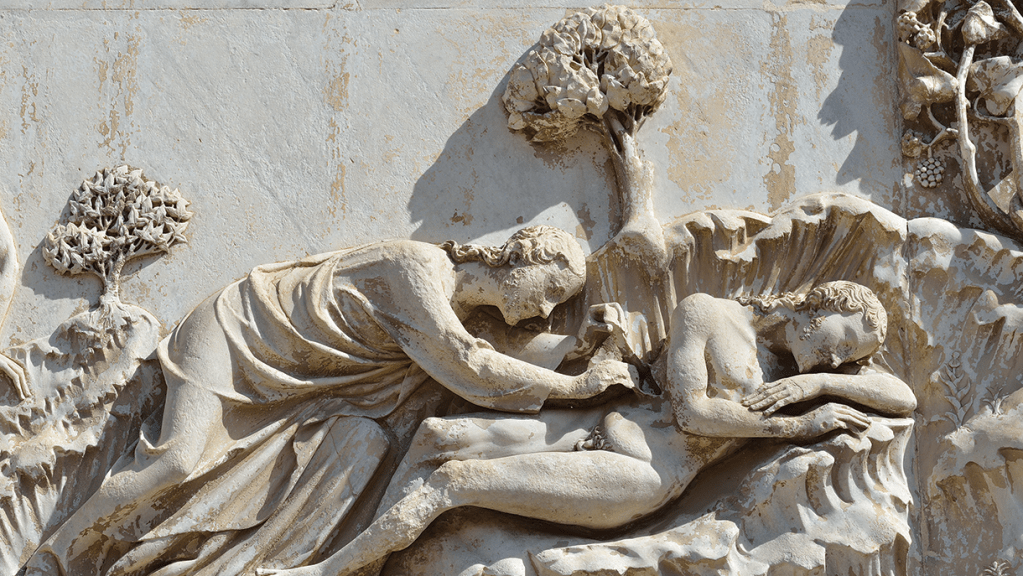
Yep, you guessed it, mother! is Aronofsky’s latest bible movie (the other being his 2014 film, Noah). Of course, I’m being anything but cryptic with my glib little biblical parody, and the film is equally transparent. Aronofsky makes these biblical parallels obvious, particularly early on, so that we don’t get bogged down deciphering subtle allusions. This is wise because it frees us up to absorb the many unique aspects of the film. Of course, everything I have summarized so far has essentially been a stylish adaptation of the book of Genesis: the creation of Heaven and Earth, Adam and Eve, Cain and Abel, and the flood myth. It is at this point in the story that mother! transitions from adaptation to allegory (broadly speaking). That is to say, the first half of the film frames the creation of our species in biblical terms, and the second half reflects our history through a biblical lens.

This allegory commences when Him’s poem (i.e., The Bible) is published and is immediately taken as prophecy by scores of crazed devotees who make the pilgrimage to Eden. They pillage the house and set up elaborate sacraments and rituals. These new primitive pilgrims reintroduce the same conflict between Mother and Him that arose when the first batch of guests arrived, but it’s much worse this time. The religious hostility of the pilgrims rapidly escalates into utter chaos: the house is transformed into a warzone from hell just as Mother is giving birth. The zealotic pilgrims then take the baby (i.e., Jesus) from Mother, murder ritualistically, and naturally eat of its flesh. When Mother retaliates, the pilgrims beat her into a pulp until Him saves her. Despite the insanity, Him still insists they must forgive and turn the other cheek. This prompts Mother to take matters into her own hands by burning down the entire property, which destroys everyone on it except for two people: Mother, who is badly burned and barely alive, and Him, who doesn’t have a scratch on his body. Him asks Mother for whatever love she has left for him so Mother allows Him to rip open her chest and pull out her heart, which transforms into a new crystal as Mother dies. We’re back where we started with only Him, a crystal, and burnt rubble from which a new genesis occurs; Him recreates the house with a new Mother.
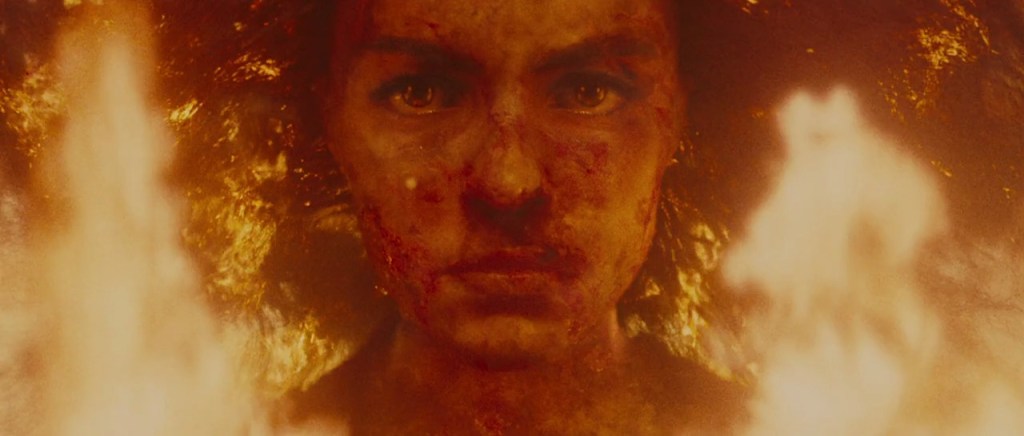
The most accessible and prevalent interpretation of this allegory is the environmental one. In this reading, mother! is a cautionary tale about the way in which zealous ideologies (be they political, religious, or economic) are driving us as a collective to turn against our Mother Earth. Like climate scientists, the film extrapolates our current attitude to show us a fate in which we incur the wrath of Mother Earth and meet our ultimate fiery doom. This interpretation has a lot of credence, especially given Aronofsky’s motives for making the film, and I’m willing to sign off on it. However, this isn’t the only layer to mother!
What elevates mother! from a very good propaganda film to a work of art is the skill with which Aronofsky deploys archetypes to give us a glimpse of a truth that is buried many fathoms beneath the sedimentary layers of politics, history, religion, and sociology, way down in the molten core of pure experience: the human mind. To be more specific, Aronofsky gives us an honest snapshot of his own mind while he was in an intense emotional state of outrage and frustration over large-scale environmental issues that he felt powerless to affect. Through this faithful translation of his subjective inner world to objective form, Aronofsky isn’t trying to save the world by warning us of the consequences of our actions; he is trying to save himself from his own destructive potential through a kind of creative alchemy.
The archetypes that I am referring to come largely in the form of the characters. One of the reasons that mother! is misunderstood and underappreciated is that many people, particularly critics, expect all the characters in good “serious” films to represent the complexity and dimensionality of real people regardless of the context in which those characters emerge. The apparent paradox of archetypal characters is that they are the ultimate composite characters in that they emerge from the collective traits of many, if not all, people and yet they often represent only one characteristic of any particular individual. As I mentioned earlier, Aronofsky doesn’t beat around the bush about the mythological context of the film, so a more literate and accurate reading of mother! is that each character only represents one aspect of the psyche, which means that the film only has one brilliantly drawn, complex, three-dimensional character and his name is Darren Aronofsky.
Of course, the key psychological duality in mother! is expressed in the relationship between Mother and Him. The most straightforward interpretation is that Him represents God, and Mother represents “Mother Earth” or an equivalent Gaia deity. Like the environmental interpretation of the allegory, this interpretation of the two central characters is true but doesn’t paint the whole picture. Think about it: it is Mother, not Him, that banishes Man and Woman (i.e., Adam and Eve) from Eden and that sees the wickedness of the guests before driving them out during the flood in the kitchen. These are actions that are attributed to God in the corresponding events in the book of Genesis. What does this say about Mother and Him as symbolic entities? Well, the answer is quite simple, really: Mother and Him are both God. I’m not saying that there is a tricky M. Night Shyamalan plot twist where we discover that Jennifer Lawrence and Javier Bardem are two sides of the same character with a split personality, rather, I’m suggesting that they each archetypically represent half of a whole. Mother is the feminine half of God: the nurturer and the divine source of love, beauty, and light. Him is the masculine half of God: the leader, the guide, the bearer of the word, and he that speaks the world into existence. Since Mother and Him are each half of their collective whole, it follows that their relationship is symbiotic: Him uses his power to create the conditions for Mother’s existence, yet Mother’s love is the source of Him’s power in the first place. Like Yin and Yang, Mother and Him arise mutually, and they cannot be understood without the other.
Given the characters in mother! are archetypes that each represent only one aspect of Aronofsky’s psyche, and since Mother and Him represent the feminine and masculine sides of God, respectively, it seems to follow that what Aronofsky is really up to is dramatizing an internal struggle between his conscious masculine ego (i.e., Him) and his unconscious feminine anima (i.e., Mother). To my reckoning, it is no accident that Him is a poet with great powers at his disposal to create a world of his own. Aronofsky is one of our most gifted and intelligent filmmakers, and his films are worlds of his own creation. Additionally, because Aronofsky is also an intuitive artist who seems to have some contact with his anima, he recognizes the destructive potential of his own masculine ego, notably when he sees dangerous, external manifestations of it on the stage of global politics. The danger of exclusive identification with masculine traits and the tacit repression of feminine traits is one we’ve seen played out throughout history, art, and literature over and over again: it blinds us to the most salient truths and emboldens the satanic tyrant that lives in all of us.
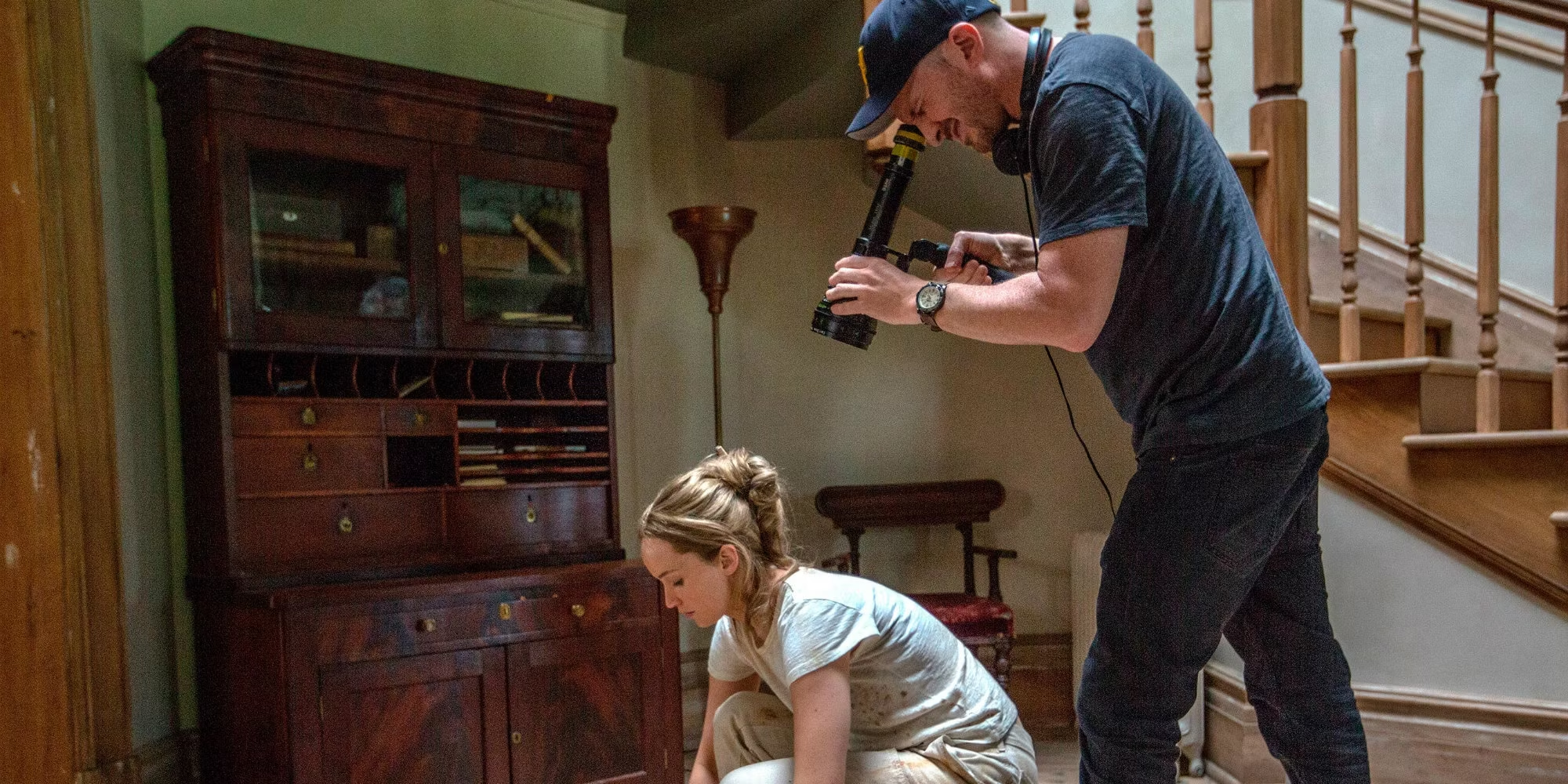
Aronofsky shows us the nightmare scenario by taking this total identification with his own masculine identity to its logical conclusion: the destruction of everything at the hand of the disavowed wrath of his feminine side. And what does Aronofsky find in this deepest pit of black? The source of his own power. When Him rips out Mother’s heart and uses her love to recreate the world, we are witnessing an artist performing the heroic act of integrating his unconscious anima into his conscious personality. By doing this, Aronofsky is transforming himself into a fuller version of himself, creating a buffer against his own tyranny and transmuting his impotence and rage into power and wisdom through a work of art. He is showing us how we might collectively transform ourselves for the better, not by lecturing or sermonizing but through a passionate demonstration.
 Grahamblings
Leave a comment